Secondary Content, Primary Risk: A Qualification Framework for Recycled Materials
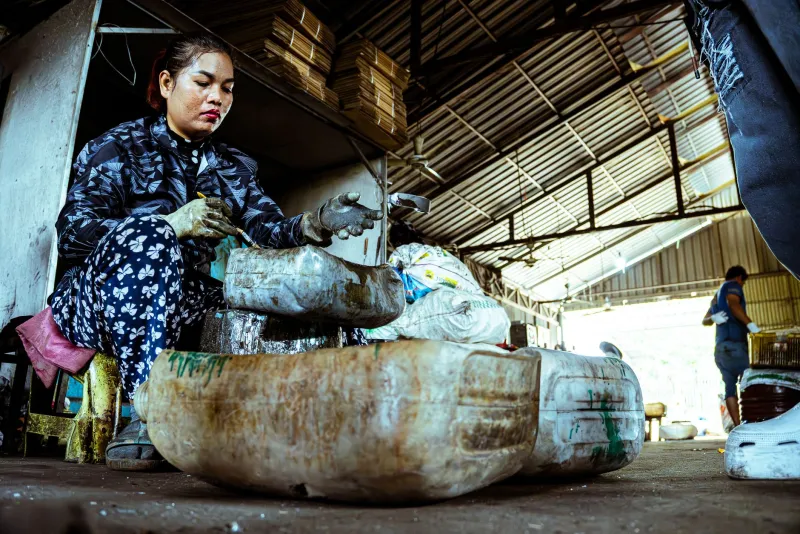
Procurement teams across US manufacturing are receiving a directive that did not exist a decade ago: increase recycled content in purchased materials, and document it. The pressure arrives from customer scorecards, state-level procurement preferences, internal sustainability commitments, and increasingly from customers who simply ask for a percentage on a specification sheet.
The risk is that sustainability language gets substituted for engineering evidence. A supplier's claim of 40 percent post-consumer content says nothing about whether the material will meet a fatigue requirement, survive a UV exposure cycle, or hold a tolerance after machining. Recycled content is a sourcing attribute. Performance remains an application question, and it must be answered with testing and qualification rather than a logo.
What the Claim Actually Says
Recycled-content declarations vary widely in rigor. Pre-consumer scrap from a manufacturer's own process is chemically similar to virgin material and usually low risk. Post-consumer content, drawn from collection streams, carries higher variability in composition, contamination, and molecular or metallurgical history. Mass-balance accounting — where a supplier credits recycled feedstock across a production run without physical segregation — is legitimate under some certification schemes but does not mean a given lot contains the stated fraction.
Before evaluating performance, establish what the number means: pre- or post-consumer, physically segregated or mass balance, third-party verified or self-declared, and calculated on which basis of weight.
Where Recycled Content Shows Up in Properties
The material science is not mysterious, and it is not uniformly negative.
Metals. Recycled aluminum and steel frequently meet or exceed virgin mechanical properties, but tramp elements accumulate. Copper and iron in aluminum alloys affect conductivity and corrosion behavior; residual elements in steel influence hardenability and weldability. Secondary alloys are often specified by a different designation precisely because their chemistry window differs.
Polymers. Repeated thermal history shortens molecular chains and broadens molecular weight distribution, which typically reduces impact strength and elongation while leaving stiffness largely intact. Mixed-color and mixed-resin streams introduce incompatible phases that act as stress concentrators and cause inconsistent molded surfaces. Contamination from labels, adhesives, and fillers changes flow and can drive odor and outgassing issues.
Composites and fibers. Recycled glass and carbon fiber retain much of their modulus but lose length and surface sizing during recovery, which reduces load transfer in the composite. Fiber length distribution becomes the governing variable.
Paper and packaging. Recycled fiber shortens with each cycle, reducing tear and burst strength; residual inks and adhesives affect food-contact compliance.
A Four-Stage Qualification Framework
Stage 1 — Application screening
Before sampling, map the application's critical requirements: structural or non-structural, static or fatigue-loaded, UV-exposed or enclosed, food-contact or industrial, tolerance-critical or cosmetic. Many recycled materials are excellent choices for non-structural, non-fatigue, enclosed applications and poor choices for the reverse. Screening prevents expensive testing of the wrong candidate.
Stage 2 — Supplier qualification
Ask for the resin or alloy designation of the recycled grade, the source stream, the segregation model, contamination controls, and any lot-to-lot variability data. A supplier who cannot describe the source stream in specific terms is not yet a qualified supplier. Site visits or process audits are warranted where the material is going into a safety-relevant application.
Stage 3 — Application-specific testing
This is where programs most often go wrong, by testing only what is convenient. Tensile testing a recycled polymer tells you little about impact performance in a cold environment. Build a test plan that mirrors the real duty cycle: fatigue where cyclic loading occurs, notched Izod or instrumented impact where shock is possible, heat deflection and creep where temperature and sustained load apply, UV and humidity conditioning for outdoor service, and melt flow consistency where molding tolerances matter. Compare against the incumbent material's specification, not against a generic datasheet.
Stage 4 — Production monitoring
A qualified lot is not a qualified stream. Set incoming inspection appropriate to the variability risk: melt flow index or spectroscopy for polymers, chemistry verification for metals, and periodic full-property re-verification on a defined frequency. Track results by supplier lot and escalate when the distribution shifts.
Documentation That Earns Its Place in the File
Distinguish between performance documentation and content documentation. A mill certificate addresses properties and chemistry. A recycled-content certification addresses the source and accounting of feedstock. Both belong in the file, and neither substitutes for the other. Where third-party verification exists under recognized standards for environmental claims, note the scope — it typically covers content accounting, not fitness for a given application.
Contractual Levers Worth Using
Specifications should state the recycled-content definition and basis, require notification of source-stream changes, and reserve the right to re-qualify when the stream or process changes materially. A supplier change in feedstock is functionally a material change and should trigger review, not merely a revised certificate.
Doing Both, Honestly
Circular sourcing and performance are not in conflict, but they are separate problems that require separate evidence. The manufacturers navigating this well in 2026 are the ones who screen applications first, qualify suppliers on traceability rather than enthusiasm, test against the real duty cycle, and keep monitoring after approval. Sustainability targets are worth pursuing. They are not a reason to skip the qualification work that every new material has always required.